Week 1 – PLN & Digital Identity
Social media helps me learn?!
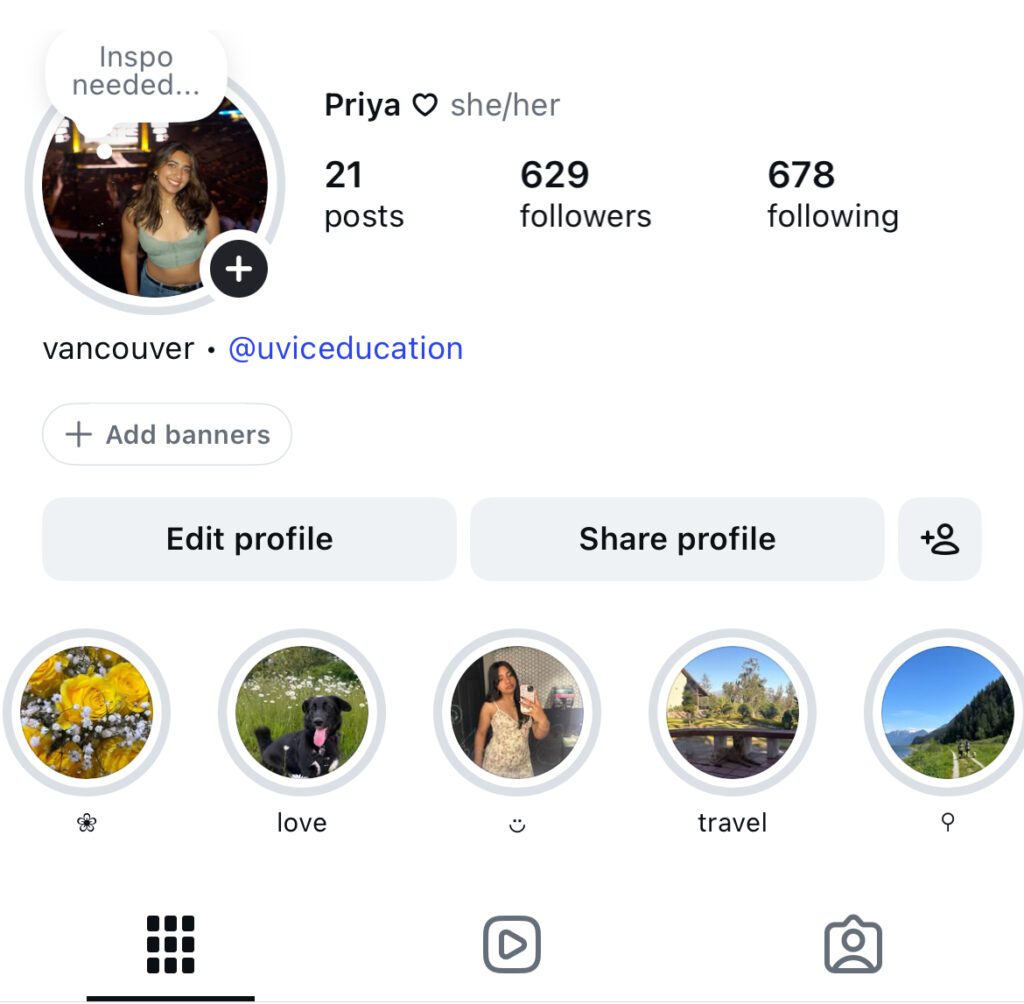
A Personal Learning Network (PLN) has never been something I was aware I had been curating. However, my social media presence on LinkedIn, Instagram, Facebook and other apps tell another story. I thought it would be interesting to begin the first blog post with an image of my main digital identity.
I was a little worried at first to showcase the featured image as my very own social media page. It felt like a bold choice, until I realized the entire world already has access to the information seen on my username, profile picture, and bio of my social media. The same way some of the followers or people I follow are parts of my own PLN, that I never noticed had a direct impact on my ideas, opinions, and learning, in life.
In simple terms we are each at the heart of our own PLN, and for me, my PLN should be my tool to support the achievement of my dream jobs, positions and opportunities in life. My understanding of my own PLN is limited right now, but I expect to see a great difference as I navigate the complicated web of networking.
For now, here are some review questions to reflect on the resources I have been able to explore so far.
PLN & Public Communication
- What does it mean to network using social media?
Networking using social media means building, maintaining, and activating relationships through digital platforms. Social media and the internet have removed the physical barriers which once existed that narrowed people’s reach to make connections on a global scale. Now, with the use of social media, people can move beyond their immediate physical communities to exchange information, collaborate, and participate in shared-interest networks. Digital networking allows users to continuously create and share knowledge to expand their learning as a professional. (FutureLearn, n.d.).
A Personal Learning Network (PLN) is an important example of how an individual’s use of online platforms can create unique and individual connections with people, resources and ideas to support lifelong learning beyond a traditional learning space, like a classroom. (Shift eLearning, n.d.)
- How are we motivated to participate in networked publics?
People participate in networked publics because online spaces provide opportunities for connection, recognition, learning, and self-expression. Social media users are motivated by the ability to maintain relationships, showcase their identity to the world, find communities with shared interests, access information, and contribute their opinions and life experiences to public conversations (Spracklen, 2014).
These networked publics create space for participation in group knowledge-building, where users are both consuming and producing the information. Participation in these spaces can develop social connections, strengthen professional networks, and create new opportunities for collaboration (FutureLearn, n.d.). Additionally, individuals may participate because visibility and recognition are valuable in digital spaces. Sharing knowledge, opinions, and achievements can help users establish and develop their online reputation (Oladimeji & Afolabi, 2017).
In an article about Digital Professional Identity, Jawed, Mahboob, and Yasmeen explain that online social networking platforms have “implications in the formation of their identity” (Jawed et al., 2019). This suggests that participation is motivated by both social connection and by the opportunity to develop and express who we are. PLNs also demonstrate this motivation because individuals use networks to access knowledge, collaborate, and continue learning outside traditional environments (Shift eLearning, n.d.).
- What are the risks and rewards of public communications?
Rewards:
- develop professional networks
- participate in communities
- sharing of knowledge
- collaboration with others
- build human connection beyond geographic limitations
Risks:
One major concern is the loss of privacy because digital platforms collect, store, and analyze user information. Online participation creates digital traces that can influence how individuals are perceived by others, including employers, educators, and professional communities (Boyd, 2012).
Another risk with the collection of data is its design to keep us “locked in and using the system”, causing real addictions to our online social networks, and making it difficult to ever unplug (Spracklen, 2014). I wonder if severe social media addictions are negatively affecting how our in-person PLN and in-person public communications are being created or maintained?
Digital Identity
- What is a digital identity?
Jawed, Mahboob, and Yasmeen describe digital professional identity as a form of identity that develops through online participation:
“professional identity that develops through internet-based social interactions by utilizing online platforms and communication tools” (Jawed et al., 2019)
According to Eric Stoller, from the University of Derby, a digital identity is the searchable footprint on the web of an individual’s online behaviour, interactions, and information shared on digital platforms (Stoller, 2016). This includes elements such as profiles, photographs, posts, comments, and online connections/relationships.
Video Reference: Eric Stoller – What is Digital Identity?
A digital identity is more than a stable online profile, but is continuously changing and constructed through an individual’s participation in online communities, and use of digital tools. A person actively shapes their own digital identity through self-presentation, while also being influenced by how others respond to and interpret their online presence.
- How do personal versus professional approaches to digital identity affect social media use?
Personal and professional digital identities influence how individuals use social media, who they form connections with and what information they choose to share.
A personal digital identity is focused on relationships, self-expression, entertainment, and sharing personal experiences. Individuals may use social media to communicate casually, express emotions, and connect with friends, family or communities. Whereas a professional digital identity focuses on credibility, expertise, career development, and reputation management. Individuals will carefully select content that demonstrates their skills, knowledge, and professional values (Oladimeji & Afolabi, 2017).
The distinction between personal and professional identities has become more and more complex because social media platforms create spaces where these identities overlap. Individuals should consider how different audiences may interpret their online presence and how their personal actions may influence professional perceptions (Springer chapter, 2014). As Eric Stoller mentioned in the University of Derby video, “What is Digital Identity”, your professional and personal digital identity may either greatly benefit or be detrimental to your future and career (Stoller, 2016).
- How do digital identities converge in networked publics? What are the impacts and/or benefits?
Digital identities converge in networked publics because social media brings together different pieces of a person’s identity, including personal, academic, social, and professional roles. A person’s online presence becomes a combination of their interactions, shared content, relationships, and participation in digital communities (Spracklen, 2014).
This can create challenges, including blurred boundaries between personal and professional life, increased visibility, and concerns about privacy and surveillance. Digital platforms make individuals more observable, meaning that online actions may have lasting impacts on reputation and identity formation (Boyd, 2012).
However, there are also significant benefits. Individuals can build larger networks, connect with diverse communities, share knowledge, develop professional opportunities, and participate in collaborative learning environments (Shift eLearning, n.d.).
A great real-life example of the blurred lines between personal and professional digital identity would be a TikTok influencer or daily vlogger who must sustain a specific image to obtain brand deals and views to bring in income but must also showcase a very personal side to draw in appeal and relate to their followers. This forms the question, which digital identity is truly at play in a professional role as a social media influencer?
Resources:
https://link.springer.com/chapter/10.1057/9781137405876_6
https://www.shiftelearning.com/blog/personal-learning-networks
https://www.futurelearn.com/info/courses/learning-network%20age/0/steps/24644
https://firstmonday.org/ojs/index.php/fm/article/view/3559/3131
https://ojs.library.queensu.ca/index.php/surveillance-and-society/article/view/networked/networked
Hi Priya,
I feel like I’ve been doing the same thing without realizing it. I never thought of my social media as a PLN either, but when you mentioned how the people we follow end up shaping our ideas and learning, it made me notice how much that’s true for me too. It’s interesting how these networks form quietly in the background while we’re just posting, scrolling, or connecting with people we already know.
Your point about privacy and digital traces also raises a bigger question about how much control anyone really has over their online identity. Even when people try to separate personal and professional spaces, everything still ends up connected because the platforms blend those roles. That overlap seems to be becoming the norm rather than something people can avoid.
I’m curious how you think your PLN will change now that you’re more aware of it. Do you see yourself shaping your digital identity differently as you start using your PLN more intentionally?
I like how you connected social media to building PLNs! Your point about learning extending beyond the classroom really shows how PLNs create opportunities to connect with people and ideas from around the world. It shows how valuable social media can be for both personal and professional growth. Really great post!!
Hi! I think it was a great choice to have your social media profile as the featured image. I had the same thoughts you did, but also came to the conclusion that my social media could be easily found anyways. My understanding of my PLN is also limited, but I am excited to learn about it alongside you this summer.
Hi Priya! I really liked your point about how we’re all curating a PLN without even realizing it. I hadn’t really thought about my own social media that way and it’s so true. The influencer example at the end was also a great way to show how blurry the line between a personal and professional identity gets. I totally agree that our online presence shapes way more of our learning than we give it credit for!