Week 4 – Finding My Voice
This week, we are starting this post with the image of a red spider web to represent the resemblance to a PLN starting from yourself at the centre and branching out into many different avenues of connection…and (mostly) to honour the release of Spider-Man Brand New Day!
This week’s blog post is a deep dive into my PLN, the networks I value, and my honest thoughts on the use of AI within the classroom and in supporting a PLN…
Disclaimer: My opinions and my boundaries with my personal and professional use of AI have been carefully made throughout the past few years based on my experiences as a young adult, student, teacher candidate, and most importantly, as a citizen and steward of this Earth. However, if you do disagree with any of my statements, my point is not to shame others on their use of AI. I solely hope to educate others and share my perspectives on the greater impact and whole picture that comes with the use of Artificial Intelligence – enjoy!
Mid-Course Thoughts & Social Media
Throughout this course, I realized that my perspective on social media in professional settings has remained fairly consistent. I have always believed that social media can be an incredible tool when it is used intentionally. It has transformed the way businesses market themselves, allows medical professionals to share accessible health information, and gives advocates, educators, and other individuals a platform to reach wider audiences.
Personally, I use social media for many aspects of my daily private life, and I also recognize the countless educational resources that teachers can draw upon for lesson ideas, professional learning, and collaboration through Personal Learning Networks (PLNs). At the same time, this course has reinforced my existing concerns about social media’s place with children. Having grown up with social media, I experienced firsthand how easily it can influence self-esteem, relationships, and the way young kids see themselves. Looking back, I know that some of those effects have lingered well into young adulthood. I do not see social media having a place within my future elementary classroom because of these shared experiences with my entire generation. While I fully support teachers using online platforms to connect with other educators and access valuable resources, I do not believe children under the age of 16 benefit from using social media.
With school phone bans being placed, I think schools now have an opportunity to encourage students to build relationships, creativity, and digital literacy without relying on social media platforms. My PLN will definitely continue to include online communities and professional resources, but my future students will engage with technology in ways that prioritize their learning, safety, and social connections over social media networking.
Who Needs to Know About My PLN?
I plan to continue growing both my professional network and the content I create, although I prefer to keep my personal social media and professional identity mostly separate. Right now, platforms like LinkedIn are where I feel most comfortable sharing my experiences and connecting with other educators. In the future, I would love to create a professional Instagram account dedicated to education where I can share classroom ideas, resources, and reflections while still maintaining boundaries between my personal and professional life.
I have already started using many of the PLN skills I developed in my professional practice. This summer, I have been working in an administrative role where I oversee a STEM outreach camp with approximately 120 campers, 15 instructors/staff members, and 30 new high school volunteers each week. The experience has taught me so much about communicating with parents and staff, collaborating with colleagues, developing curriculum, supporting students with diverse one-on-one needs, and leading a large team. It has shown me that a PLN is more than networking and is really rooted in building relationships with people who help you grow as a person and professionally. Looking ahead, I can see these skills continuing to benefit me throughout my teaching career. One of my long-term goals is to become a school principal or work in curriculum development, and I know that maintaining strong professional connections by expanding my PLN will help me get there.
The Current State of My PLN
My current Personal Learning Network (PLN) has continued to grow throughout my teacher education program and includes both online and in-person professional communities. I regularly use LinkedIn to stay up-to-date about curriculum, educational leadership, volunteer opportunities, tutoring and teaching positions, but also as a space to showcase my experiences and goals as a teacher candidate. Instagram has become another valuable part of my PLN, where I follow Canadian educators who teach within the B.C. curriculum and share practical classroom resources, ideas for teaching the First Peoples Principles of Learning (FPPL), approaches to integrating Indigenous perspectives into everyday learning and how to navigate Core Competencies into lesson planning. I also subscribe to Make a Future, which sends emails for teacher job postings across British Columbia. Although I am not yet in a position to apply for most of these roles, it helps me understand where teachers are most needed and allows me to prepare for my future career. Other than online networks, my volunteering at North Saanich Middle School introduced me to mentor teachers who influence my professional growth, as well as my professors at the University of Victoria have been able to provide both academic support and real educator perspectives. One of the most meaningful additions to my PLN has been maintaining my connections with teachers from my international practicum in Tanzania, including the Dean of the University of Dar es Salaam and the other mentor teachers and educators from the primary school where I taught.
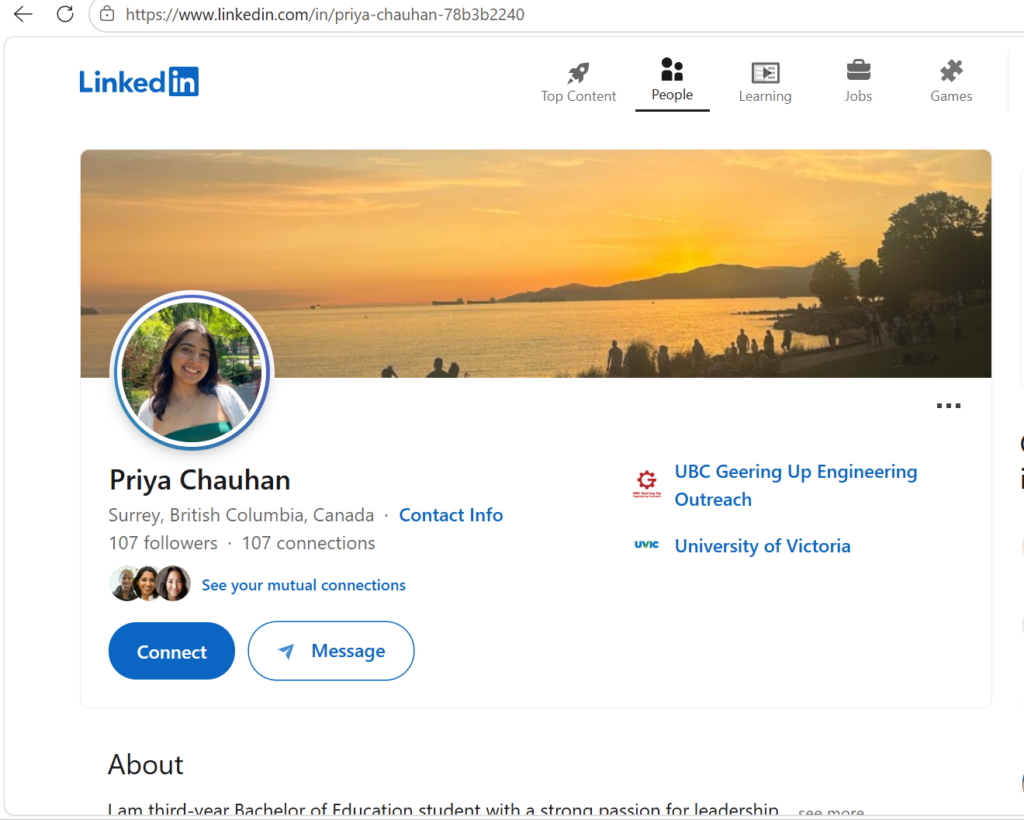
Priya Chauhan – UBC Geering Up Engineering Outreach | LinkedIn
A study done by Nielsen et al. (2010), The Teacher Education Conversation: A Network of Cooperation Teachers”, examined a professional learning community consisting of cooperating teachers and university educators in British Columbia who met regularly to discuss mentoring, teaching practices, and teacher education. Rather than relying on traditional professional development workshops, participants learned through ongoing conversations, collaboration, and reflection. Although the study refers to a professional learning community rather than a PLN, the principles are the same. Educators strengthen their practice by building supportive relationships and learning from one another. I found that this reflects my own PLN which includes mentor teachers from North Saanich Middle School, my UVic professors, curriculum developers at my current STEM outreach job, and international connections from Tanzania who each I collaborated with, learned from and was mentored by as a teacher candidate. As Nielsen et al. (2010) conclude, “The relationship between a cooperating teacher and a teacher candidate has the potential to enable the sorts of explorations evident in the Conversation that deepen and widen teachers’ understandings of their work, both in the classroom and in mentoring teacher candidates” (p. 861).
My PLN: Strengths, Weaknesses
Strengths:
- Specific to my field of study
- I actively seek out diverse perspectives – Indigenous voices, educators internationally etc.
- I am expanding my connections beyond Canada
- Using my current job-experiences and co-workers or employers to help support my growth and development as a teacher and into more jobs that closely align with the skills I wish to build
Weaknesses:
- most connections are in Education or Humanities
- not enough connections closely link me to the Vancouver School Board (VSB) – my ideal school board to work with post-graduation
- Many surface-level connections on my LinkedIn because it is still in progress
The Role of AI
Reflecting on PLN, AI, and the article, “Building AI Literacy in Pre-Service Teacher Education in Canada”, I think my biggest questions are whose voices are being heard, who has access, and who is being left behind. One of the reasons I struggle with AI (other than its deep environmental impact) is its lack of diverse perspectives. Most AI systems are still built from datasets that reflect a limited view, and we already see the consequences of that. For example, medical AI has been criticized for being trained primarily on white male bodies, contributing to poorer outcomes and misdiagnoses for women and people of colour (who already are systemically more likely to be misdiagnosed by regular doctors). If these systems are already biased, why are we so eager to rely on them? I understand that AI has benefits, particularly for accessibility through tools like translation, speech-to-text, or supporting learners with diverse needs, but I also think we need to ask who these technologies are really serving. To me, many of the technologies being developed today seem to benefit the top 1% far more than the people who need them most. The article also notes AI may widen educational inequalities when access to technology is unequal (Estaiteyeh and Mindzak, 2025). If much of the Global South still lacks access to technology, why do we continue pouring resources into advancing the Western world and in turn, widening the gap between those who have access and those who do not? I also share many of the other concerns identified in the study. AI can reinforce bias, raise questions about academic integrity, and encourage students to rely on quick answers instead of developing critical thinking skills (Estaiteyeh and Mindzak, 2025) .
This Is How Kids Should Be Learning with AI, Priya Lakhani, 2026
In the video above, Priya (not me), does a great job of providing positive points in how students may use AI to offset the one-size-fits-all approach in the curriculum. Despite me not agreeing with many of her points in the use of AI with students, I can respect her want to offset student burn-out, make students’ academic rates grow and overall support future learners the best they can be.
As a future teacher myself, I don’t want my classroom to be centered around work efficiency or finding the fastest shortcut because a tool exists. Teaching, to me, is about helping students become curious individuals who will be stewards for the world, its land, animals and people after my generation passes. I want students to ask questions, think critically, and develop empathy for those whose experiences are different from their own. That is why I value PLNs more than AI. My PLNs greatest strength is that it exposes me to real educators, researchers, Indigenous voices, and teachers from different communities who challenge my thinking and help me grow. Of course, weaknesses exist within my PLN as well, such as my lack of connections on the mainland and in my hometown Vancouver, or the surface-level connections that are in the process of development and my main connections being those in educational or humanities-careers. But, despite the places for growth, I firmly believe that unlike AI, a PLN allows me to hear multiple perspectives, question my assumptions, and supports my growth through real first-hand experiences, and as such I personally, will not use AI in the development of my PLN.
References
Estaiteyeh, M., & Mindzak, M. (2025). Building AI literacy in pre-service teacher education in Canada: A case study of two cohorts. Journal of Teaching and Learning, 19(4), 135–154. https://doi.org/10.22329/jtl.v19i4.10041
Nielsen, W. S., Triggs, V., Clarke, A., & Collins, J. (2010). The teacher education conversation: A network of cooperating teachers. Canadian Journal of Education, 33(4), 837–868. https://cje-rce.ca/index.php/cje-rce/article/view/2194
Qualman, E. (2012). Empower others. In Digital leader: 5 simple keys to success and influence (Chapter 16). McGraw-Hill.
Hi Priya, happy Spiderman release! I saw it in theatres and thought it was one of the best spider man movies yet! I really appreciated your disclaimer about your opinion on A.I…I have very similar opinions to you and find it such an important thing to make sure that other people know I am not shaming them in their stance, but also trying to inform on what I have learned. I loved reading your blog! It was separated into a really nice flow and was engaging all the way through.