Week 2 – Before the Interview, There’s Google

Digital Identity For Emerging Educators
Image Captured by: Priya Chauhan
Have you ever Googled yourself and wondered what a future employer would find?
As a teacher candidate, I’ve started to realize that my online presence is much more than a collection of social media accounts, but it represents who I am as both a person and a future professional. Maybe what I post, the apps I use and the moments I share, show a bigger picture to my identity… especially to employers.
Visitor & Resident Maps
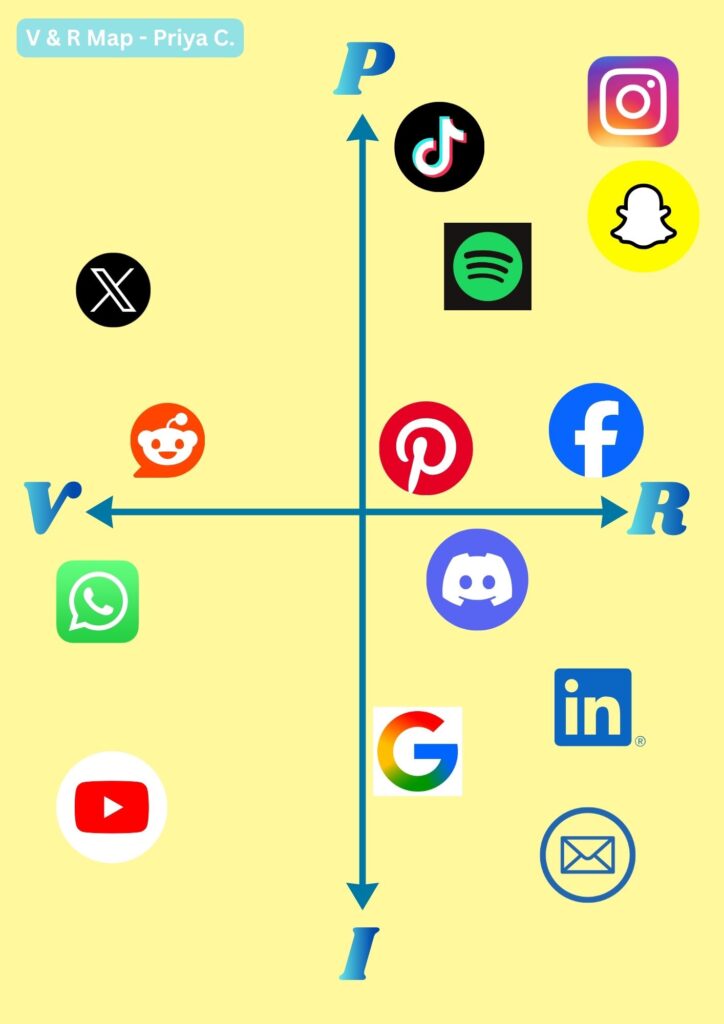
My online presence is already a lot more nuanced than I had previously thought. It not only about what I post, but my frequency of usage, and my trackable presence across each digital platform. Visitor & Resident Mapping (V & R) is a significant way to track one’s digital platform patterns, and to see what kind of online presence I have (White and Le Cornu 2017). Visitor Mode (V) is equivalent to picking out a tool to use in a garden shed, and placing it back in the same space, ultimately leaving no trace of your entry (White and Le Cornu 2017). Whereas, Resident Mode (R), are the places you inhabit on the web, like your social media platforms and accounts that are all traceable forms. The Y-axis is where we see the context of our usage. Is it Personal (P)? Or is it Institutional (I) and work related? I noticed specifically for my map that I do not follow the exact common patterns as listed in the FirstMonday article. However, I feel I am close to the V-R, because all quadrants have some usage, and I typically use my technology for my professional work as a summer camp manager or teacher candidate, for my school work as an undergraduate student, and of course, as a young Gen Z individual.
Personal Digital Identity vs Professional Digital Identity
- What digital platforms are students currently using to develop their professional network?
Students today use a variety of digital platforms to build connections, collaborate with peers, and share knowledge. Rather than relying on one platform, many students use different tools depending on whether they are communicating personally or professionally.
According to White and Le Cornu (2017), people engage with digital platforms along a continuum between being Visitors, who use the internet as a tool to complete tasks, and Residents, who actively participate by creating content, communicating with others, and building relationships. They emphasize that these are “modes of engagement rather than as innate learning styles,” meaning students move between these approaches depending on the situation and context.
The article also explains that many undergraduate students are comfortable using social networking sites in both their personal and educational lives. Students commonly use platforms such as LinkedIn, Facebook groups, and blogs to collaborate on projects, communicate with classmates, and build new networks while studying.
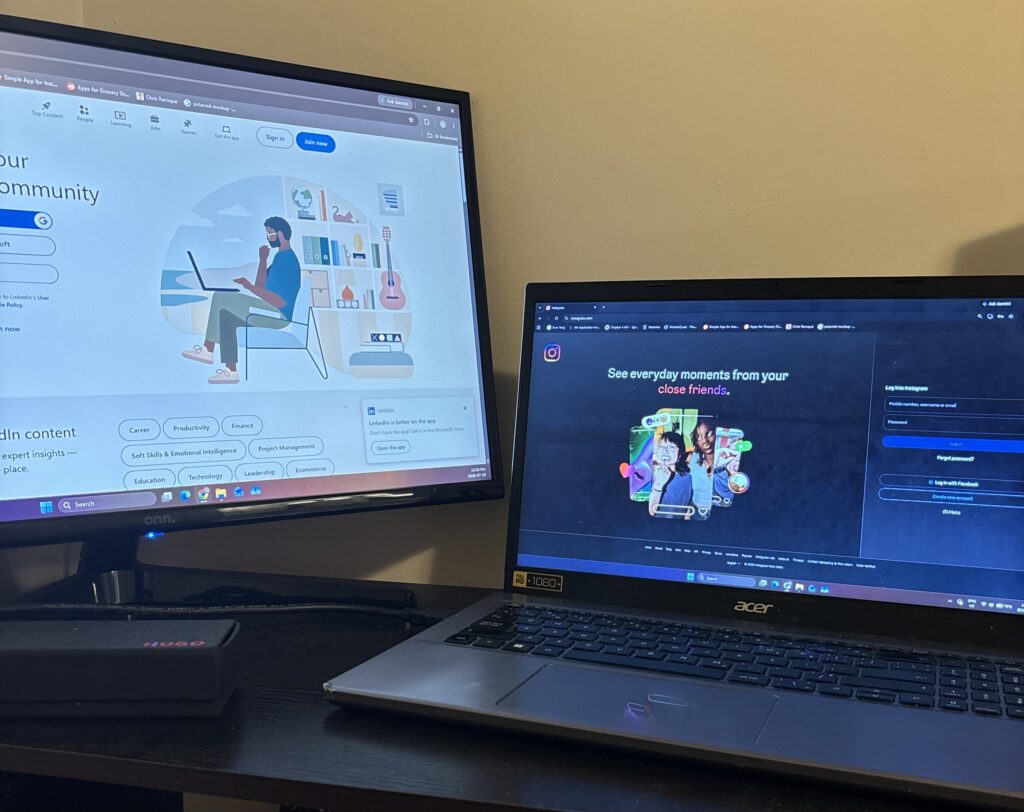
As a university student, I regularly use Instagram to stay connected with friends and classmates, while Brightspace and Outlook email help me communicate with instructors and complete coursework. Although I have a LinkedIn profile, I realize I have not been actively using it to network with educators or showcase my professional experiences, but the educator platforms on LinkedIn are not as large of communities as for students from different faculties such as Business or Engineering.
2. What could the student consider in expanding their professional learning network?
One of the biggest lessons I learned is that building a professional learning network (PLN) is about creating meaningful connections with each person rather than increasing the number of followers or contacts on a platform.
White and Le Cornu explain that digital technologies have blurred the boundaries between personal and professional spaces, making it easier to participate in multiple communities online. They note that the digital world has “erod[ed] traditional temporal and architectural demarcations of social and professional behaviours,” meaning our online identities increasingly overlap across different contexts.
For me, expanding my PLN could include:
- connecting with experienced teachers and education organizations on LinkedIn
- following educational researchers and classroom teachers who share ideas and resources
- participating in online discussions or debates about teaching practices and curriculum
- sharing lesson ideas, reflections from practicum, or professional achievements with peers or mentors
3. How might an employer respond to my digital identity?
If I were applying for a teaching position today, I believe an employer would likely look at my social media profiles before making a hiring decision. My digital identity could either strengthen or weaken their first impression of me (but I obviously hope it would strengthen!).
Springer (2018) discusses how educational technologies collect and use personal data, raising ethical questions about privacy, transparency, and digital responsibility. It argues that students should become informed digital citizens who understand how their online actions and data contribute to their broader digital identity. These ideas reinforce that every online interaction we have contributes to the professional image we present to others (Springer, Ethical Challenges of EdTech, Big Data and Personalized Learning).
As for my own social media, I think an employer would firstly notice my private accounts, which is an important factor in keeping the boundaries between personal and professional life. Additionally, I avoid posting content that could be viewed as inappropriate or offensive. However, they may occasionally find the ancient TikTok accounts or fanpages I had made as a child that I forgot the passwords for, but generally I do not believe that content could weaken one’s professional opinions on me today.
An employed may also notice that I have limited professional content related to education. I could strengthen my digital identity by sharing classroom experiences (while respecting confidentiality), professional development opportunities, volunteer work, and reflections about teaching and learning.
4. How do data privacy and security limit and/or promote a Professional Learning Network (PLN)? How can I create a positive digital identity?
Building a Professional Learning Network (PLN) offers many opportunities to learn from others, but it also requires being mindful of privacy and security. Digital platforms make it easier to connect with educators around the world, but they also collect large amounts of personal data. Springer explains that educational technologies usually gather and analyze user data to personalize learning experiences, raising important ethical concerns about privacy, consent, and transparency. These concerns can make some users, even myself, hesitant to fully participate in online communities because they may not know how their information is being stored or shared (Springer 2018).
At the same time, when digital platforms are used responsibly, they can strengthen a PLN. Educators can collaborate, exchange teaching ideas, access professional development opportunities (attend online PD days), and build supportive communities beyond their own schools. White and Le Cornu explain that digital engagement is about how individuals choose to participate in online spaces, as Visitors or Residents. Developing confidence in navigating these spaces and knowing in which context may help students build their PLN while being aware of their digital footprint.
Conclusion
As a future teacher, I want my digital identity to reflect professionalism, curiosity, and respect. I can build a positive online reputation by sharing educational resources, engaging respectfully in professional discussions, connecting with other educators, and thinking carefully before posting. One passion of mine is social justice, and that one aspect of my identity is still what I wish to share with the world, despite how controversial it may be in today’s age. Inclusion is at my utmost importance as a future teacher so I would also hope to share ways that teachers can implement inclusive ways of engagement and learning into their classrooms. By being intentional about my online presence, I can develop a digital identity that supports both my career and my lifelong learning journey.
Resources:
White, D., & Le Cornu, A. (2017). Visitors and Residents: Mapping engagement with the digital. First Monday. View of Using ‘Visitors and Residents’ to visualise digital practices | First Monday.
Springer, (2018). Ethical Challenges of Educational Technology, Big Data and Personalized Learning. Ethical challenges of edtech, big data and personalized learning: twenty-first century student sorting and tracking
Hi Priya! I really liked your comments about how, in a digital world, educators can connect around the world, but still be wary of the privacy risks that can be involved with it. I also agree with intentionality when it comes to an online presence so it supports your career.
Hi Priya! I really enjoyed reading your blog. I liked how you talked about balancing your personal and professional identity online because I think that’s something a lot of us are still figuring out. I also thought it was funny when you mentioned your old TikTok accounts because I feel like everyone has something from years ago they’d rather employers not find 😂. Your point about building a PLN through meaningful connections instead of just collecting followers really stood out to me. Overall, it was a really relatable and thoughtful post!